Debate on SSRIs in Pregnancy Is Shifting: What the Latest Relapse vs Risk Evidence Shows
If you take an antidepressant and just learned you are pregnant, stopping overnight is not the only medically serious option. Newer research says staying on medicine often protects you more than it harms the baby, once doctors account for the illness itself. The decision is a weighing of two real risks, not a test of whether you want a 'clean' pregnancy. The medicines in question are selective serotonin reuptake inhibitors (SSRIs), a common class of antidepressants. MedPage Today summarized the shifting consensus: stopping raises maternal relapse (relative risk 2.30), and studies that control for psychiatric confounders do not show strong evidence of direct birth defects from the drugs.
Based on reporting from MedPage Today: Debate on Use of SSRIs in Pregnancy Shifting, Experts Say.
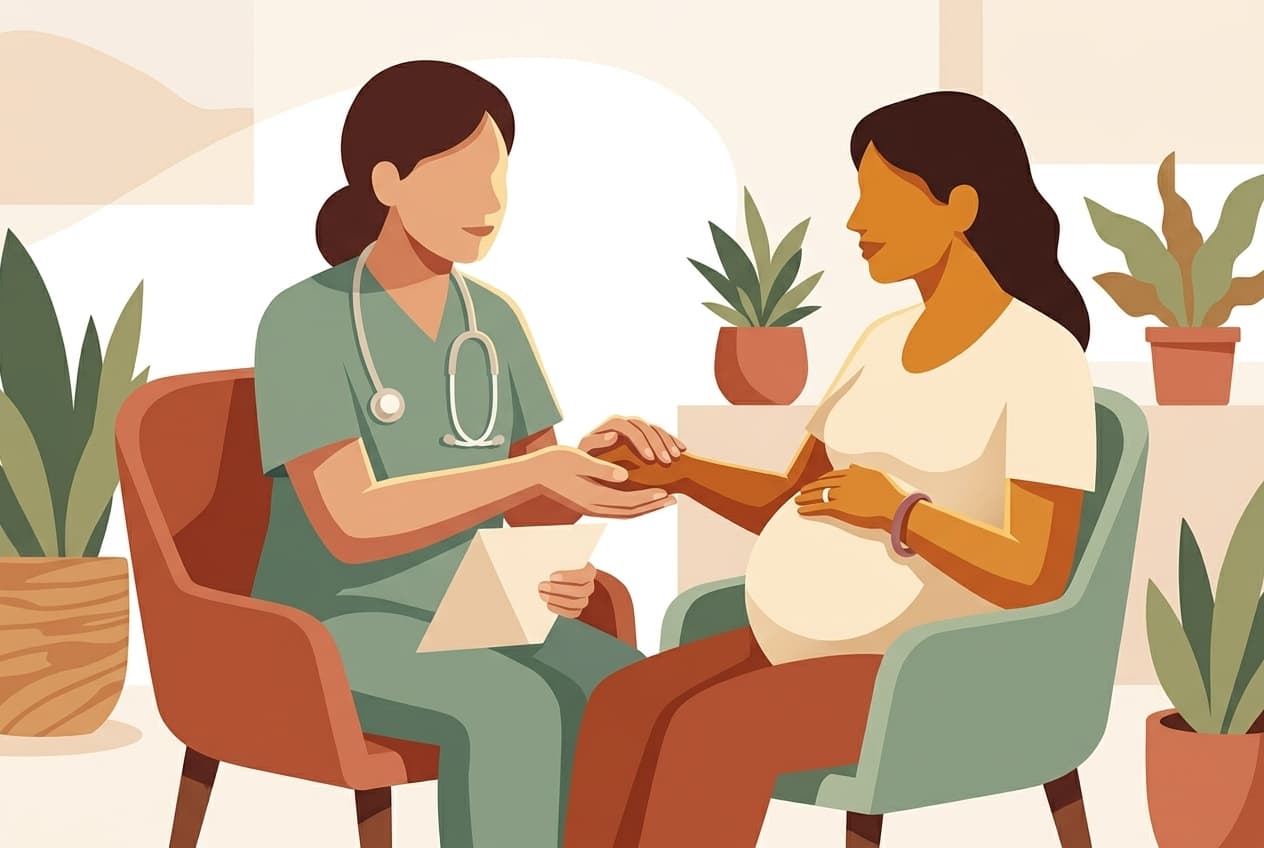
If you were told to throw out your pills the day of a positive test, start here
That advice is common. It is also often incomplete. Fear that a medicine will 'hurt the baby' is a protective instinct. Fear that you will relapse and not get out of bed is also protective. Both belong in the same conversation.
You are not a better parent for suffering untreated depression. You are not reckless for wanting data before you continue a pill.
The short version of the newer evidence: stopping an SSRI more than doubles relapse risk, and after researchers account for the underlying illness, the extra risk of major birth defects attributable to the drug approaches the usual population rate. The numbers and the newborn-adaptation details follow.
Why older studies looked scarier than they were
For decades, pregnant patients on SSRIs received conflicting guidance, and many were told to taper immediately. Earlier studies that linked SSRI exposure to congenital anomalies (birth defects present at birth) often failed to control for maternal psychiatric illness, substance use, chronic stress, and lifestyle factors.
When contemporary studies account for those confounders (other variables that can explain the outcome), the absolute risk of major fetal malformations directly attributable to SSRIs approaches baseline population rates. The illness and the context were doing more work than the molecule.
The Science Behind ItRelapse risk 2.30, and two newborn issues
Patients who discontinue antidepressant therapy during pregnancy experience a relapse rate greater than 60%, compared with about 26% among those who maintain therapy (relative risk 2.30). Relapse is not only emotional. It tracks with fewer prenatal visits, poorer nutrition, higher circulating cortisol and catecholamines (stress chemicals), and higher risk of preterm labor and low birth weight. After birth it raises postpartum depression, anxiety, and attachment strain.
Clinicians also discuss two newborn issues. Persistent pulmonary hypertension of the newborn (PPHN) is high blood pressure in the lungs that makes it harder for a baby to oxygenate. Large cohorts show a modest relative increase with late-trimester SSRI exposure, but the absolute risk stays low: about 3 to 4 cases per 1,000 live births versus a baseline of 1 to 2 per 1,000.
Neonatal behavioral adaptation syndrome (sometimes abbreviated NBAS) occurs in about 20% to 30% of infants exposed near term. Symptoms are usually mild and short-lived: jitteriness, mild breathing irregularity, or altered sleep in the first 48 to 72 hours. Hospital teams, including midwife-attended units, watch for these signs without routinely separating parent and baby.
Clinical Insight for ProvidersShared decisions, not reflexive tapers
Do not apply a blanket stop rule. Weigh psychiatric trajectory (frequency, severity, hospitalizations, self-harm), the molecule and dose that achieved remission, and non-drug adjuncts such as cognitive behavioral therapy. Then write a postpartum safety plan with visits at 1, 2, and 6 weeks.
Counsel with intervals, not slogans. Relapse relative risk 2.30 is the maternal-risk number families can use. PPHN absolute risk remains in the low single digits per thousand. Adaptation symptoms are common and usually self-limited. Say those three facts in the same visit.
Use the midwife's full clinical scope where state rules allow it. A midwife who only 'refers out' for every SSRI question recreates the fragmentation that leads people to stop medicine in the parking lot.
In Arizona: CNM perinatal mental health and prescribing
In Arizona, Certified Nurse-Midwives independently prescribe Schedule II through V medications, screen with the Edinburgh Postnatal Depression Scale and PHQ-9, and coordinate with perinatal psychiatry.
If you are delivering in an Arizona hospital, ask your midwife who writes the refill, who sees you in week one, and how psychiatry backup works. The Arizona hub and practice directory list hospital-affiliated clinics that already do this work.
A four-part conversation worth having before the next refill
- Your psychiatric history: how bad episodes have been, and what happened the last time you stopped medicine.
- Medication stability: which drug and dose kept you well before conception.
- Non-drug supports: therapy, movement, sleep, and who will help at night after birth.
- Postpartum timing: who checks on you in week one, not only at the six-week visit.
Questions this headline raises
For many patients the benefits of preventing depressive relapse outweigh potential newborn effects. Major organizations, including ACOG and the American Psychiatric Association, support continuing SSRIs in pregnant people with moderate to severe depression through structured shared decision-making. That is not the same as saying every person must stay on every dose.