What the Banner Casa Grande Labor and Delivery Closure Means for East Valley Birth Options
Banner Casa Grande Medical Center has paused childbirth services because it could not staff enough obstetric physicians. Families in Casa Grande, Maricopa, San Tan Valley, and southern Pinal County now need a different hospital for labor. That change is stressful, but nearby East Valley hospitals still offer full maternity care, including hospital-based midwives with epidurals and physician backup. The pause took effect August 1, 2026. Prenatal clinics at the Casa Grande campus remain open. Planned inpatient birth now routes to Chandler, Gilbert, and Mesa hospitals, typically a 35- to 55-minute drive.
Based on reporting from Regional Arizona Health Reports: Banner Casa Grande to pause labor and delivery services due to provider shortages.
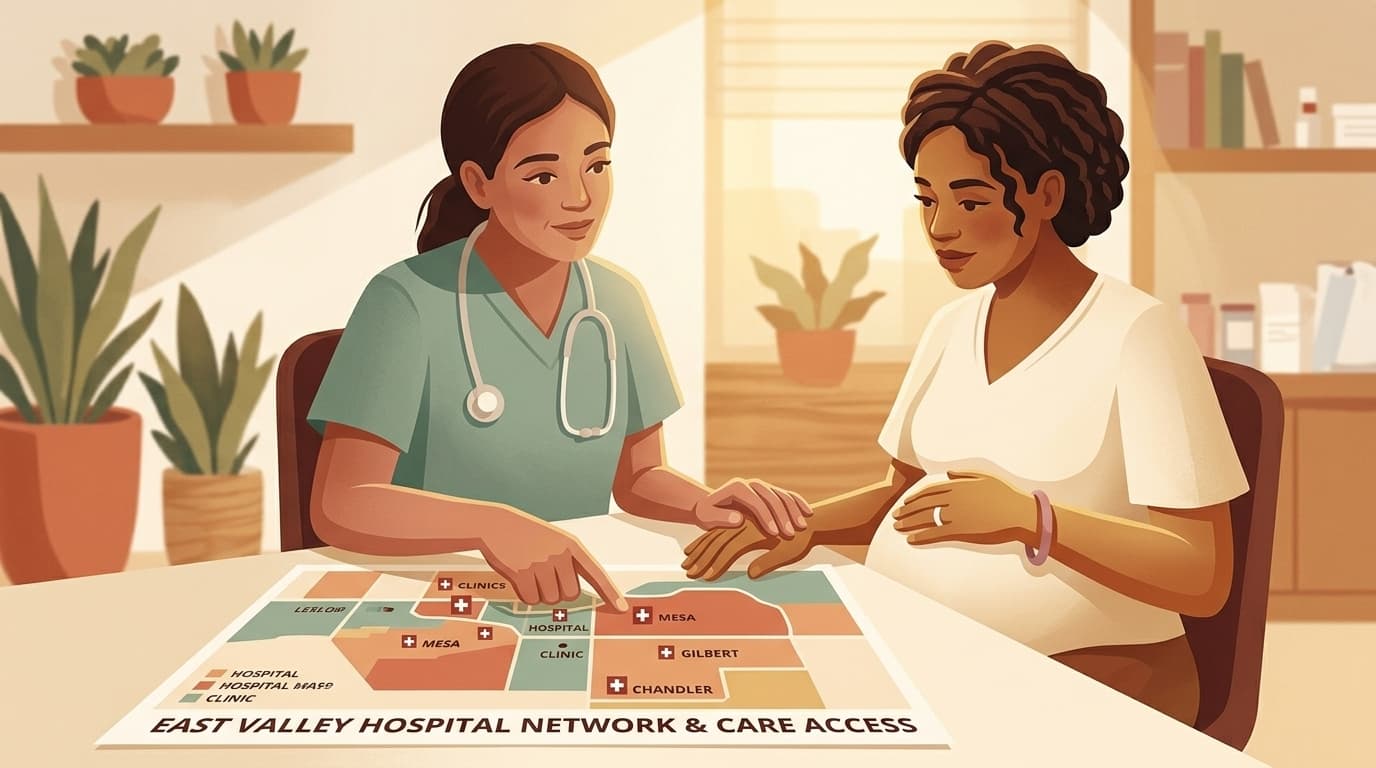
If your planned birth hospital just closed its labor unit, start here
Losing a local birth unit late in pregnancy feels like the ground moved. You are not overreacting. A 35- to 55-minute drive in labor is a real safety and logistics problem, especially if you have had fast labors before or do not have reliable transportation.
The pause is about physician staffing, not about your pregnancy being 'too complicated' for the region. Prenatal care can stay local. Birth now needs a hospital that still runs a staffed labor floor.
The short version: pick an East Valley maternity hospital, move your records, practice the drive, and pre-register. The longer version, with named hospitals and how midwives fit, follows below.
What changed on August 1, 2026
Banner Casa Grande Medical Center suspended labor and delivery unit operations because of ongoing obstetric physician recruitment challenges. Prenatal care clinics and gynecological services remain operational at the site. Inpatient childbirth services require redirection to neighboring medical centers.
The change hits families in Casa Grande, Maricopa, Eloy, Coolidge, and southern Pinal County. People who planned a local delivery now face typical drives of 35 to 55 minutes to accredited maternity hospitals in Chandler, Gilbert, and Mesa.
East Valley hospitals that still attend births
Families affected by the closure have several high-volume maternity facilities within a reasonable driving radius:
- Banner Ocotillo Medical Center (Chandler): off the Loop 202, with private labor suites, Level II neonatal care (care for moderately ill or premature newborns), and integrated hospital midwifery services.
- Mercy Gilbert Medical Center (Gilbert): Level III NICU support (a higher-acuity newborn intensive care unit), comprehensive birth preferences, and high-touch collaborative obstetric teams.
- Chandler Regional Medical Center (Chandler): Level III NICU capabilities, 24/7 in-house OB-GYN physician coverage, and a full pain-management range.
If you were scheduled to deliver at Banner Casa Grande, contact your prenatal clinician now to start record transfer and hospital pre-registration.
The Science Behind ItWhy a physician shortage closes a labor floor
A labor unit is not a clinic with extra beds. It requires 24-hour obstetric coverage, anesthesia, nursing, and the ability to move to cesarean (surgical birth) without a long transfer. When a hospital cannot recruit enough obstetric physicians, it cannot honestly staff that chain.
This is the same workforce pattern behind national maternity-care deserts: low rural reimbursement, night call burden, and liability costs concentrate births into larger metro hospitals. Casa Grande is a local example of that national map.
Collaborative midwifery does not replace the missing obstetricians. It does let a hospital that still has a labor floor stretch bedside care. Certified Nurse-Midwives are Master's-prepared Advanced Practice Registered Nurses certified by the American Midwifery Certification Board. In Phoenix, Chandler, Gilbert, and Peoria hospitals they manage low-risk and moderate-risk labor beside attending obstetricians.
Clinical Insight for ProvidersTreat the drive time as a clinical variable
For patients living south of the East Valley, travel time is now part of the risk assessment. Ask about prior precipitous labor (very fast labor), preeclampsia symptoms, and reliable transportation. Document a primary hospital and a backup route.
Do not assume the Casa Grande prenatal clinic automatically completed pre-registration at Ocotillo, Mercy Gilbert, or Chandler Regional. Confirm privileges, insurance facility status, and a records packet before 34 weeks.
Counsel the emergency-department distinction clearly. The Casa Grande ED remains open. It is not a planned labor unit. Patients who present there in advanced labor will be stabilized and transferred when possible. That is not equivalent to a staffed maternity floor.
If the patient wants midwifery continuity, match them to a CNM group that already admits at the destination hospital. Continuity fails when the midwife and the new hospital are strangers to each other.
A four-step plan for the next prenatal visit
First, verify admitting privileges. Confirm where your obstetrician or Certified Nurse-Midwife delivers and that your insurance covers that hospital facility.
Second, drive the route at rush hour. A 40-minute map estimate can become an hour on the I-10 or Loop 202.
Third, pre-register with the maternity department by week 32 so admission is not a clipboard exercise in active labor.
Fourth, rewrite the birth plan for the new unit: movement, hydrotherapy, epidural timing, and who to call when contractions start.
Questions this headline raises
The Banner Casa Grande Emergency Department remains open 24/7 for medical emergencies. For planned inpatient labor, birth, and routine maternity admissions, patients are directed to nearby full-service maternity hospitals.